Exhaust Systems Explained: Cat-Back vs Axle-Back, Sound vs Drone, and Legal Reality
An exhaust is the modification people buy for sound and then regret for drone. Understanding what the system actually does — and which part produces which behavior — is what separates a good purchase from an expensive mistake you live with on every highway commute.
An exhaust is the modification people buy for sound and then regret for drone. Understanding what the system actually does — and which part produces which behavior — is what separates a good purchase from an expensive mistake you live with on every highway commute.
What each section does
A modern exhaust has four functional zones, and changing each one produces a different result:
Manifold / header. Collects exhaust from the cylinders. Changing this is the biggest power change available in the exhaust system, and the most invasive and expensive.
Downpipe. Connects the manifold to the catalyst. On turbo cars, the downpipe is where the most restriction lives — a high-flow downpipe is the single largest exhaust-side power gain on a turbo engine. Often the most emissions-sensitive part and the one most likely to fail inspection.
Catalytic converter. Reduces emissions. High-flow cats exist and are legal in some jurisdictions, not others. “Test pipe” and “catless” replacements are illegal for road use nearly everywhere and will fail inspection. We don’t recommend them for street cars.
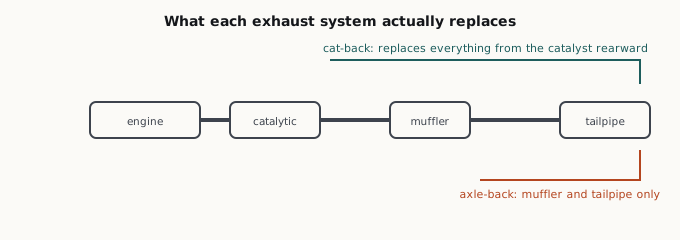
Cat-back. Everything from behind the catalyst to the tailpipe: mid-pipe, resonator, muffler, tail sections. This is where sound and tone are made. Power gains are usually small — often in the 5–15 hp range on a naturally aspirated engine, and largely a matter of removing restriction rather than adding flow capacity.
Axle-back. Just the muffler and tailpipe behind the rear axle. Cheapest way to change sound. Power gain is close to zero. Best option if sound is the only goal and budget is tight.
The drone problem
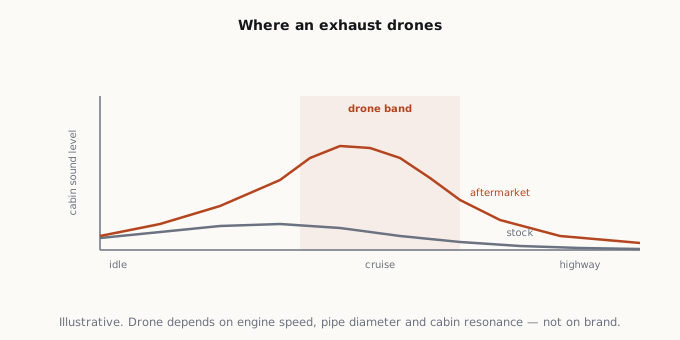
Drone is a low-frequency resonance that occurs at a specific engine RPM — typically 1,800–2,500 rpm, which is exactly highway cruising speed. It’s not the same as loudness: a system can be loud at wide-open throttle and quiet at cruise, or modest at full throttle and unbearable at 70 mph.
Drone comes from the system’s resonant frequency matching a cabin harmonic. The tools against it, in order of effectiveness:
- Keep a resonator. Removing the resonator is the most common cause of drone. A well-designed system keeps one, or adds a Helmholtz-style chamber to cancel a specific frequency.
- Choose the quieter muffler variant. Nearly every brand sells a “touring” and a “race” version. The touring version is what you want on a daily.
- Keep the system’s diameter appropriate. Oversized pipe (3.5” on a 300 hp engine) reduces exhaust velocity and often increases drone while hurting low-end torque.
- Retain the factory valve system if equipped. Active exhaust valves let you have quiet cruise and loud throttle. Cars that come with them from the factory — many modern performance models — can be programmed rather than replaced.
Test drive before buying if at all possible, and specifically listen at steady 70 mph in top gear. A shop that will let you hear the system on a customer car is worth driving to.
The power question, honestly
We won’t quote horsepower figures for exhausts we haven’t dyno-tested. What we can say about the mechanism:
- On a naturally aspirated engine, a cat-back typically yields a modest gain, with most of it at high rpm. You feel it near redline more than in daily driving.
- On a turbo engine, the downpipe is where real gains are; the cat-back behind it usually yields a small additional amount.
- A tune is what unlocks exhaust gains. Adding flow without changing the ECU’s fueling and boost targets leaves most of the benefit unrealized. This is also the point where warranty considerations get serious.
Be skeptical of any “up to +25 hp” claim on a cat-back with no dyno chart attached.
Materials
409 stainless. The most common OEM material. Adequate, will surface-rust, lasts roughly 5–10 years depending on climate and road salt.
304 stainless. Better corrosion resistance, the standard for quality aftermarket systems. Costs more. In salt-belt climates this matters.
Aluminized steel. Cheapest. Will rust through in a few years in wet or salted conditions. Avoid for a car you plan to keep.
Titanium. Light and exotic, used on high-end systems. Expensive, can be brittle, and overkill for street use.
Welds matter as much as material. Look for TIG welds rather than MIG, mandrel bends rather than crush bends, and flanges rather than slip joints where possible.
Sound versus neighbors and legality
Nearly every US state and most countries regulate exhaust noise and emissions equipment. Practical rules that keep you out of trouble:
- Do not remove the catalytic converter on a road car. It’s a federal offense in the US and fails inspection nearly everywhere.
- Know your local noise limit. Many US states set a limit around 95 dB at a specified distance; some municipalities are stricter. Enforcement is inconsistent but real.
- Cold start is the loudest moment. Many systems are much louder for the first 30 seconds, which is when neighbors notice.
- Check inspection requirements before buying. Some systems alter the position of emissions sensors and will fail a plug-in scan, even if they physically fit.
The honest summary
If sound is your goal and budget is tight: axle-back, touring muffler, keep everything else. If you want a real character change with a small power benefit: cat-back with a resonator, quality 304 stainless. If you’re chasing power on a turbo car, spend on the downpipe plus a tune rather than on a louder cat-back — and understand exactly what that does to your warranty and inspection status before you commit.
Buy for cruise behavior, not for the full-throttle sound clip. You’ll spend 99% of your driving time at part throttle, and that’s the sound you have to live with.